Microsoft Access Services
MS Access Purchase Request Approval Workflow
MS Access-Based Application for Multi-Level Purchase Request Approvals
Overview
Managing internal purchase requests manually often leads to delays, confusion, and compliance risks-especially when approval chains grow complex. That’s why the MS Access Purchase Request Approval Workflow is designed to give organizations a structured, automated way to handle procurement requests from submission to final approval. This tool centralizes every step-request creation, approval, tracking, and reporting-inside a role-based MS Access application. Built with flexibility and control in mind, it helps reduce bottlenecks, ensure accountability, and provide full visibility of procurement activity without relying on expensive platforms or email-based workflows.
What Is the MS Access Purchase Request Approval Workflow?
Create and submit structured purchase requests:
Standardize procurement entries with required fields like department, item details, cost estimates, and justification to ensure consistency and clarity.
Route requests through multi-level approval workflows:
Automatically send requests through predefined approval chains based on role and amount, reducing delays and manual handoffs.
Define role-specific and amount-based approval rules:
Assign approval permissions by role and cost range to enforce compliance and ensure proper authorization at each level.
Track status changes and maintain full audit trails:
Monitor every action-submission, approval, rejection, or update-with time-stamped records for transparency and accountability.
Export reports, view logs, and analyze activity by department or category:
Gain insights through powerful filters and generate summaries to track trends, identify bottlenecks, and support informed decisions.
Manage users and roles in a centralized, admin-controlled interface:
Easily add, modify, or deactivate users, configure role permissions, and maintain data integrity-all from a single control point.
Whether you're overseeing a finance department, managing department heads, or handling IT procurement, this system ensures that every request follows the right path-with the right people-before any funds are spent.
Who Is It For?
Mid-sized companies and departments needing structured approval paths:
Helps implement formal procurement workflows with clear accountability across multiple departments and roles.
Procurement teams that need centralized tracking and reporting:
Offers a single platform to monitor request statuses, approvals, and purchasing trends-eliminating fragmented communication.
Organizations seeking to replace email-based or spreadsheet-based approval flows:
Replaces unreliable, manual methods with a structured, auditable system that enforces approval rules and prevents oversights.
Teams without an ERP system who want structured internal controls:
Provides a cost-effective alternative to full-scale ERP software by adding workflow governance and transparency within Access.
Whether you’re a startup scaling operations or an established business needing tighter process compliance, this tool adapts to your workflow.
Core User Roles and Permissions
Requestors:
Can create, edit, and submit purchase requests. Once submitted, they can no longer modify them.
Approvers:
Review and act on pending requests assigned based on their role, approval amount limits, and workflow sequence.
Admins:
Manage all users, rules, data, and reports. Can update request statuses, reassign roles, and perform master data management.
Each user sees only what they need, making the experience simple and secure.
Key Features
Submit a Purchase Request
Request Date, Department, and Category:
Define the origin and purpose of the request for routing and reporting.
Requested Items, Quantity, and Estimated Cost:
Capture the purchase details that will inform approval routing and budgeting.
Purpose or Justification:
Add context to the request to support approver decisions.
Once submitted, the request is locked and automatically routed into the approval chain-eliminating unauthorized changes and ensuring audit consistency.
Approval Workflow Logic
Role-based routing:
Requests flow to approvers with specific roles (e.g., Manager, Budget Head).
Amount thresholds:
Only approvers authorized for the request’s cost range can act.
Sequential approvals:
Requests move from one level to the next based on ApprovalOrder.
Approve:
Passes to the next level (or marks as ready for purchase if final step).
Reject:
Returns the request to the originator with status “Returned to Requestor.”
Hold:
Temporarily pauses the approval process, marking it “On Hold.”
Real-Time Status Tracking
On Hold
Paused for clarification or review
Purchased
Finalized; the item has been acquired
Cancelled
Officially cancelled by admin
Returned to Requestor
Rejected and sent back for revision
Admins or procurement officers can update statuses manually or via workflow triggers, giving stakeholders immediate visibility into what’s happening.
Reports, Logs & Audit History
Request history by date, department, or category:
Spot trends, monitor high-volume departments, or flag recurring categories.
Approval logs:
Track who approved what, when, and at which level-supporting transparency and compliance.
Audit history:
View records of status changes, edits, and user actions for full traceability.
Admin Configuration & Master Setup
1. Manage Users (tblUsers)
Define roles, departments, and user status (active/inactive): Easily assign roles such as Requestor, Approver, or Admin, and organize users by department for workflow targeting. Deactivated users automatically stop receiving request assignments: Inactive accounts are excluded from approval workflows to maintain integrity and prevent routing errors.
2. Define Approval Rules (tblApprovalRules)
Rule Name (e.g., High Value Approval):
Label rules clearly to identify their purpose or threshold level in the approval chain.
Min/Max approval amounts:
Set monetary boundaries that determine which requests a rule applies to-ensuring the right people approve the right amounts.
Role ID required for approval:
Specify which user role (e.g., Department Manager, Finance Head) is authorized to act on this rule.
Optional department filter:
Apply rules only to specific departments if needed-enabling granular control over request routing.
Approval sequence number (ApprovalOrder):
Define the order in which approvals must happen, supporting multi-level workflows with structured escalation.
3. Manage Master Data Tables
tblDepartments:
Used to group and segment requests by internal teams or business units.
tblBudgetCategories:
Helps classify types of spending (e.g., IT, Marketing, Operations) for better reporting and budget control.
tblRoles:
Assigns permission levels and determines what each user can see or do within the system.
tblVendors: (optional)
Maintain vendor records for future use in reporting, procurement, or potential purchase order generation.
Visual Workflow Flowchart

See the Approval Workflow in Action
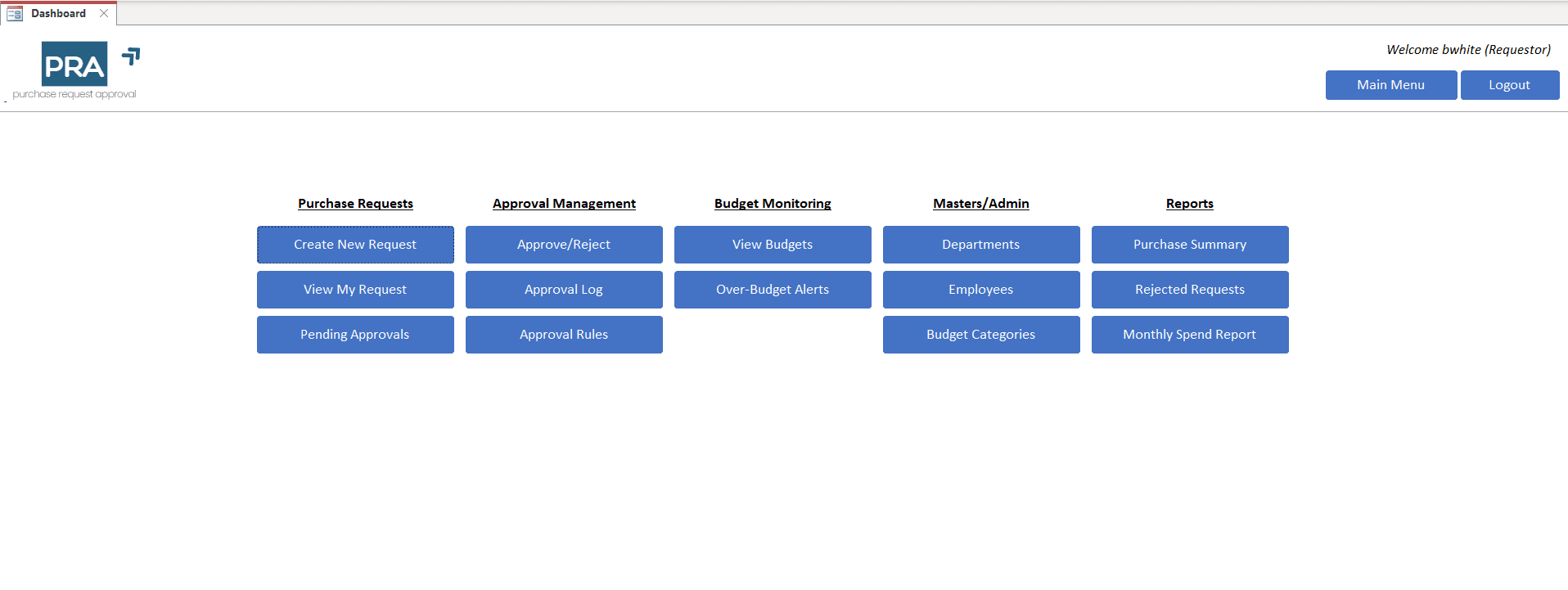
Browse screenshots of the Purchase Request Approval Access application.
Error Handling & System Feedback
Missing fields?
User prompted before submission.
Out-of-range amounts?
System routes to higher-level approval.
No approver found?
Alert sent to Admin to adjust rules.
Unauthorized actions?
“Access Denied” message blocks unpermitted activity.
Pro Tips & Best Practices
Export any form to Excel for backup, review, or team sharing.
Use dashboard buttons like “Print,” “Export,” or “View Logs” to simplify admin work.
Keep user roles current-deactivated users won’t receive approval tasks.
Regularly review approval rules to reflect changes in your org structure.
For email alerts, Outlook VBA integration can be added to trigger reminders or approvals.
FAQ
Frequently Asked Questions
Find answers to common questions about our services
Known Limitations
Single-request routing-no parallel approvals.
No built-in email notifications (can be added manually).
Dependent on shared network performance for multi-user access.